
AEO vs GEO vs SEO: Why SEO Is Still the Foundation of AI Search
3rd Oct, 2026
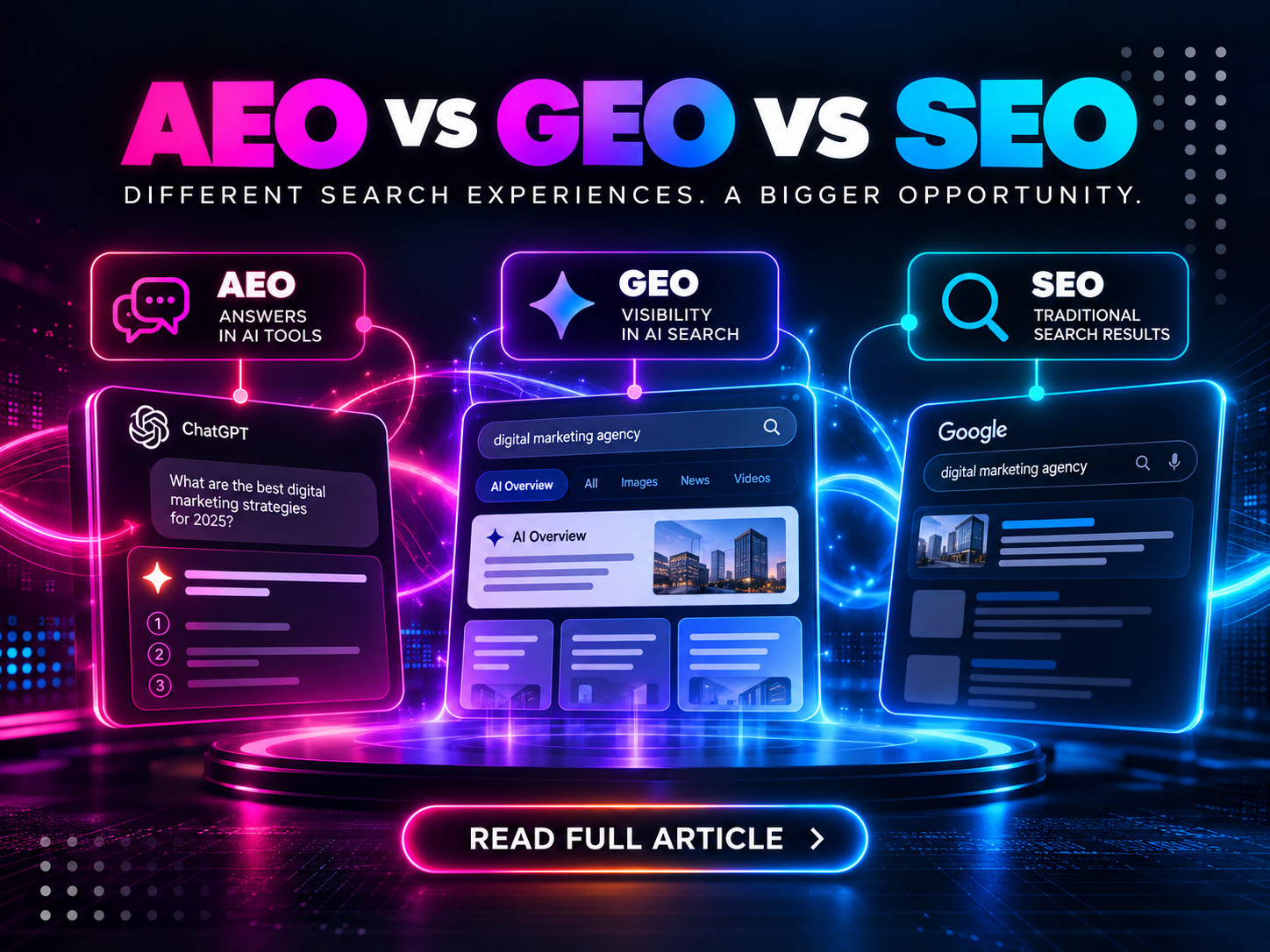
AEO. GEO. LLMO. AIO. AI SEO. AI Search Optimisation.
At this rate, digital marketing is going to run out of acronyms before it runs out of people announcing that SEO has been replaced.
Every few months, a new term seems to enter the conversation. Suddenly, there are webinars explaining why you need to “move beyond SEO”. Agencies are launching entirely new services. LinkedIn is full of posts warning businesses that traditional search is over. And somewhere, inevitably, someone is explaining that your entire digital strategy needs to change because users are now asking ChatGPT questions instead of typing everything into Google.
There is just one problem.
The foundation underneath most of this is still SEO.
That does not mean answer engine optimisation (AEO) is meaningless. It does not mean generative engine optimisation (GEO) is simply a marketing gimmick. And it certainly does not mean businesses should ignore the enormous changes taking place in AI search.
Search behaviour is changing.
The interfaces are changing.
The way answers are presented is changing.
The way visibility should be measured is changing.
But crawlability did not suddenly stop mattering. Technical site health did not become irrelevant. Content quality did not disappear. Authority did not vanish. Internal linking did not become obsolete. Search intent did not stop existing.
In fact, Google's own guidance on generative AI search continues to emphasise many of the same principles businesses should already recognise from a strong Search Engine Optimisation strategy: accessible content, useful information, internal linking, technical accessibility and a website that search systems can properly understand.
So before we bury SEO underneath another pile of three-letter acronyms, it is worth understanding what AEO vs GEO vs SEO actually means — and, more importantly, how these disciplines fit together.
AEO vs GEO vs SEO: What Do All These Terms Actually Mean?
Part of the confusion around SEO vs AEO vs GEO comes from the fact that the terminology is still evolving.
There is no universally accepted industry standard that neatly separates every term. Different platforms, agencies, researchers and technology providers use the acronyms slightly differently.
That alone should probably make us slightly suspicious of anyone insisting that one acronym has completely replaced another.
At a practical level, though, the differences can be understood fairly simply.
|
Term |
Meaning |
Primary Goal |
|
SEO |
Search Engine Optimisation |
Improve visibility, rankings and organic discovery through search engines |
|
AEO |
Answer Engine Optimisation |
Make information easy for search and AI systems to retrieve and present as a direct answer |
|
GEO |
Generative Engine Optimisation |
Improve visibility, citations and brand inclusion within generative AI responses |
|
LLMO |
Large Language Model Optimisation |
Improve how a brand, entity or content is understood and represented by LLM-powered systems |
|
AIO |
AI Optimisation / sometimes AI Overview Optimisation |
A loosely used umbrella term for optimisation around AI-powered discovery |
|
AI SEO |
AI Search Engine Optimisation |
An informal way of describing SEO adapted to AI-powered search experiences |
Notice something?
There is an enormous amount of overlap.
That is because we are not talking about six completely separate marketing disciplines. We are largely talking about different aspects of discoverability, retrieval, understanding, authority and visibility within an increasingly AI-mediated search ecosystem.
What Is SEO?
Search Engine Optimisation is the practice of improving a website's ability to be discovered, understood and surfaced by search engines for relevant searches.
That includes technical SEO, content optimisation, keyword and intent research, site architecture, internal linking, metadata, authority building, structured data, page experience and many other elements.
Ideation Digital's SEO services, for example, incorporate technical SEO, on-page optimisation, off-page optimisation, keyword research, content and competitor analysis as connected parts of the overall search strategy.
Traditionally, the most visible outcome of SEO was fairly straightforward:
Your page ranked → somebody clicked it → they arrived on your website.
AI has complicated that journey.
It has not made the underlying discipline disappear.
What Is Answer Engine Optimisation?
Answer engine optimisation focuses on making information easy for systems to identify, understand, extract and use when answering a question.
The idea makes sense.
If somebody asks:
“What is the difference between SEO and GEO?”
an answer engine needs content that clearly explains the distinction.
A page that buries the answer beneath 900 words of unnecessary scene-setting may be less useful than one that provides a clear definition and then adds context, evidence and detail.
AEO therefore places additional emphasis on things like:
-
Clear answers
-
Logical headings
-
Strong information architecture
-
Explicit definitions
-
Relevant FAQs
-
Structured content
-
Direct responses to specific questions
-
Supporting context
Useful? Absolutely.
Entirely disconnected from good SEO and content marketing practices?
Not even slightly.
What Is Generative Engine Optimisation?
Generative engine optimisation generally refers to improving the probability that a brand, website or source appears within AI-generated responses.
The term gained academic prominence through the 2024 research paper GEO: Generative Engine Optimization, which explored how content changes could influence visibility within generative engine responses.
GEO therefore tends to focus more heavily on concepts such as:
-
Citation visibility
-
Source authority
-
Evidence
-
Factual clarity
-
Brand mentions
-
Entity relationships
-
Third-party corroboration
-
Whether generative systems use your content when constructing an answer
That creates an important distinction from traditional search.
With SEO, success may mean ranking highly enough to earn the click.
With GEO, success may also mean your business is referenced, cited or incorporated into the generated response — even when the user never visits a traditional search results page.
That is a meaningful change.
But meaningful change is not the same thing as replacement.
The Big Change Is the Search Interface, Not the Need to Be Discoverable
For decades, the search journey looked something like this:
Question → Search engine → Search results → Website → Answer
AI search increasingly allows the journey to look more like this:
Question → AI/search system → Synthesised answer → Sources and optional further exploration
That shift matters enormously.
Google AI features can synthesise information from multiple sources. Microsoft Copilot can generate answers grounded in web content. Platforms such as ChatGPT and Perplexity can retrieve information from the web and produce direct responses.
Users increasingly expect answers rather than lists of links.
But here is the part that gets lost in all the excitement:
Those systems still need information to work with.
Information needs to be discovered.
Pages need to be accessible.
Content needs to be understood.
Entities need to be identified.
Claims need to be supported.
Sources need to demonstrate relevance and authority.
Which brings us to the point that somehow needs saying:
You cannot optimise content for an AI-powered search experience if the underlying systems struggle to discover, access, interpret or trust the content in the first place.
This is also why Ideation Digital approaches digital growth from a broader digital strategy perspective rather than treating individual channels as isolated tactics. Search visibility is influenced by far more than what happens on one page.
Why SEO Is Still the Foundation of AI Search Optimisation
The easiest way to understand the relationship between SEO, AEO and GEO is not to imagine three competing circles.
Think of them as layers.
SEO provides much of the technical and content foundation.
AEO places additional emphasis on answer retrieval and extractability.
GEO places additional emphasis on how content and brands appear within generated responses.
AI search optimisation is therefore not about throwing SEO away.
It is about expanding what we optimise for.
Crawlability Still Matters
Before a search engine can rank content, it needs to discover and process it.
And before many AI-powered search systems can retrieve current web content, that content also needs to be accessible.
That sounds suspiciously like technical SEO because, well, it is.
A beautiful FAQ written specifically for AEO is not particularly useful if your website has indexing problems.
A perfectly crafted GEO landing page is not going to save a broken canonical structure.
And adding schema to content that search engines cannot reliably crawl is the digital equivalent of putting a very attractive sign on a shop nobody can enter.
This is why a proper SEO strategy starts with understanding the health of the website itself. A Digital Health Audit can help identify gaps in website performance, search visibility, competitive positioning and the broader digital ecosystem before businesses start chasing the newest optimisation trend.
Site Architecture and Internal Linking Still Matter
AI did not magically remove the relationships between pages on your website.
Internal links help users navigate.
They help search engines discover content.
They reinforce relationships between topics.
They help establish information hierarchy.
They support the broader topical ecosystem around important commercial pages.
They can also guide both search systems and users from informational content towards deeper resources or relevant services.
So when businesses ask how to improve their GEO while their site has dozens of orphaned pages, confused category structures and important services buried four clicks deep, we may want to solve the less fashionable problem first.
A strong digital marketing strategy still needs a coherent website and content architecture underneath it.
Search Intent Did Not Stop Mattering Either
One of SEO's most useful disciplines has always been understanding why somebody is searching.
Are they researching?
Comparing?
Trying to solve a problem?
Looking for a supplier?
Ready to buy?
AI interfaces make those journeys more conversational, but they do not eliminate intent.
If anything, generative search can reveal intent in even greater detail because users can ask longer, more specific and more contextual questions.
A user might previously have searched:
“best digital marketing agency”
Now they could ask:
“Which digital marketing agency would be best for a small South African business that wants more leads from Google but only has a limited monthly budget?”
That is not the death of search intent.
That is search intent wearing a much more detailed outfit.
The underlying need has not disappeared. The user is still looking for a digital marketing agency. They are simply giving the search platform more context about their business, their goal and their constraints.
SEO strategies built around genuinely understanding customer questions, buying journeys and informational needs are therefore remarkably well positioned for AI search.
This is also why search cannot be viewed as an isolated channel. Search behaviour connects with the broader customer journey, content strategy and marketing funnel.
Our article on understanding the modern digital marketing funnel explores exactly why SEO, content, social media, Google Ads, AI and other channels need to work as part of one ecosystem rather than competing for credit.
Authority Did Not Suddenly Become Optional
Generative systems have a difficult job.
They need to produce useful answers while deciding which information is reliable enough to incorporate.
That makes authority, evidence and corroboration important.
And once again, this should sound familiar.
For years, strong SEO strategies have focused on:
-
Building genuinely useful content
-
Demonstrating expertise
-
Earning credible mentions
-
Strengthening topical authority
-
Establishing trustworthy information
-
Supporting claims with evidence
-
Developing a recognisable brand footprint
GEO adds a new potential outcome:
Being used or cited within an AI-generated response.
But the path towards that visibility still benefits from doing the difficult work of becoming a source worth using.
The lesson is not:
“Add three statistics and ChatGPT will love you.”
Please do not turn that into the next SEO industry hack.
The more useful lesson is that specific, credible, well-supported information gives generative systems something valuable to work with.
Which is also simply good content.
Good Content Is Still Good Content
Perhaps the most entertaining part of the current GEO conversation is watching practices that have been recommended by good SEOs for years reappear wearing new name badges.
Provide clear answers.
Use meaningful headings.
Structure information logically.
Demonstrate expertise.
Answer the user's actual question.
Create original research.
Support claims with evidence.
Build topical depth.
Keep information current.
Use descriptive internal links.
Avoid thin content.
Make important information easy to find.
Apparently, we needed several new acronyms to rediscover that useful websites should contain useful information.
This is why content marketing remains such an important part of search visibility. Long-form articles, service pages, research, FAQs and thought leadership all give search and AI systems more context with which to understand a business and its expertise.
This is where SEO for AI search starts to become genuinely interesting.
Not because the old rules are gone.
Because the pressure to create information that actually deserves to be surfaced is getting stronger.
So Are AEO and GEO Just SEO With Better PR?
Not quite.
And this is where the conversation needs more nuance.
Saying that SEO is the foundation does not mean nothing has changed.
It has.
AEO and GEO draw attention to outcomes that traditional SEO reporting did not always prioritise.
A brand may now care about whether it appears inside an AI-generated comparison.
A publisher may want to know whether its articles are being cited by AI systems.
A business may need to evaluate whether ChatGPT, Gemini, Copilot or another AI platform understands its products correctly.
Marketers may need to monitor not only rankings but also:
-
AI mentions
-
Citations
-
Recommendation contexts
-
Brand representation
-
Topic association
-
AI referral traffic
-
Visibility within generated answers
That means the questions we ask are changing.
Not just:
“Where do we rank?”
But:
“Where are we being referenced?”
“Which pages are being used as sources?”
“How does AI describe our brand?”
“Which topics are we associated with?”
“Are competitors being cited where we aren't?”
“Does our content answer the kinds of questions people now ask conversationally?”
Those are useful questions.
They simply do not require us to hold a funeral for SEO first.
For a broader look at how businesses should be thinking about the technology itself, read our guide to understanding AI in digital marketing.
Where AEO and GEO Actually Add to Traditional SEO
The most sensible approach to AEO vs GEO vs SEO is therefore not choosing one.
It is understanding where newer AI-search considerations expand the existing discipline.
Traditional SEO historically placed heavy emphasis on earning visibility within search engine result pages.
Modern AI search adds another layer:
Making content useful during retrieval, synthesis and citation.
That can influence how we write.
Definitions may need to be more explicit.
Important facts should not be buried beneath vague marketing language.
Pages should clearly establish who a company is, what it does and which products, services or topics it is associated with.
Expert claims should be attributable.
Statistics should have sources.
Original research becomes increasingly valuable.
Brand and entity information should remain consistent across the web.
And content should work well at passage level as well as page level.
In other words, the optimisation target is broadening.
But broadening is different from replacing.
LLMO, AIO and AI SEO: Do We Really Need More Acronyms?
Naturally, AEO and GEO were not enough.
Enter LLMO, AIO, AI SEO and various other attempts to name the same rapidly evolving space.
What Is LLMO?
LLMO usually means Large Language Model Optimisation.
It typically refers to improving how content, brands and entities are understood or represented by LLM-based systems.
That may include work around:
-
Entity clarity
-
Brand mentions
-
Structured information
-
Third-party sources
-
Expert attribution
-
Consistent business information
-
Topical associations
Again: useful area of focus.
Again: substantial overlap with SEO, digital PR, content marketing and brand authority.
What Is AIO?
AIO is particularly entertaining because the acronym itself is not consistently defined.
Some marketers use it to mean AI Optimisation.
Others use it specifically in discussions about AI Overview optimisation.
This is perhaps a useful reminder that we should not restructure an entire marketing department every time the industry produces another abbreviation.
What Is AI SEO?
AI SEO is arguably the least exciting term and therefore possibly the most useful.
It generally describes adapting SEO strategies to account for AI-driven search experiences.
No dramatic declaration of a new discipline required.
Just SEO evolving because search is evolving.
Imagine that.
No, Traditional SEO Alone Is Not Enough Either
There is another extreme worth avoiding.
If one side of the industry is shouting:
“SEO is dead, everything is GEO now.”
the other side cannot simply respond:
“Nothing has changed.”
That would also be wrong.
Search is clearly changing.
AI-generated results alter how information is presented.
Zero-click and low-click experiences change how visibility should be valued.
Generative systems can combine multiple sources into a single response.
Users can conduct complex research conversationally rather than running ten separate queries.
Brand visibility can occur without a traditional organic click.
Third-party websites may influence how an AI system understands a business.
And measurement increasingly needs to account for citations and representation, not only traffic and rankings.
The correct response is therefore not to choose between SEO and AI search optimisation.
It is to evolve SEO strategy to account for a broader search environment.
That is also why an integrated digital marketing approach matters. Search, content, paid media, social media, brand authority and website performance influence one another. Trying to optimise one element in complete isolation creates an incomplete view of how people — and increasingly machines — discover a business.
What a Sensible AI Search Optimisation Strategy Should Actually Look Like
Rather than creating completely separate SEO, AEO, GEO, LLMO and AIO strategies that all fight each other for budget, businesses would be better served by building one integrated search visibility strategy.
1. Fix the Technical SEO Foundation First
Make sure important content can be crawled, rendered, indexed and understood.
Review:
-
Site architecture
-
Canonicals
-
Redirects
-
XML sitemaps
-
Internal links
-
Page performance
-
Structured data
-
Mobile usability
-
Indexation
-
Duplicate content
Before chasing fashionable AI tactics, make sure the basics work.
2. Research Questions, Not Only Keywords
Keyword research remains useful.
Very useful.
But it should now sit alongside deeper research into:
-
Conversational questions
-
Comparison queries
-
Customer objections
-
Buying concerns
-
Product use cases
-
Decision-stage questions
-
Industry terminology
-
Long-tail contextual queries
People have always searched for answers.
AI interfaces simply allow them to express those questions in much more detail.
3. Build Genuine Topical Authority
Create connected content around subjects your business has a legitimate right to speak about.
Do not publish one random blog article simply because a keyword tool says the phrase receives 500 searches a month.
Build clusters.
Connect related articles.
Support your service pages.
Answer questions at different stages of the buying journey.
Strengthen important topics over time.
This is where SEO, content marketing and internal linking need to work together.
4. Make Important Information Explicit
Clearly define:
-
Products
-
Services
-
Industries
-
Locations
-
Processes
-
People
-
Concepts
-
Areas of expertise
Do not force users — or machines — to decode three paragraphs of corporate poetry to understand what you actually do.
If you provide enterprise payroll software, say that.
If you manufacture composite decking, say that.
If you are a digital marketing agency offering SEO, say that.
Clarity is useful for humans.
It is also extremely useful for machines.
5. Create Evidence Worth Citing
This is where GEO becomes genuinely interesting.
If everybody publishes essentially the same summary of an existing topic, why should an AI system choose yours?
Create information other sources do not have.
That could include:
-
First-party research
-
Original statistics
-
Industry surveys
-
Case studies
-
Expert commentary
-
Proprietary methodologies
-
Original comparisons
-
Data analysis
-
Real examples
The objective should not simply be to write content.
It should be to contribute something useful to the information ecosystem.
6. Strengthen the Wider Brand Footprint
Your website matters.
But your website is not the only place where your brand exists.
Reputable third-party mentions, industry references, publications, reviews, directories, social profiles, associations and media coverage can all help establish who your business is and what it is known for.
This is where SEO starts overlapping heavily with:
-
Digital PR
-
Brand building
-
Reputation management
-
Content distribution
-
Social authority
Which is another reason Ideation Digital's integrated digital marketing model makes more sense than treating SEO as a completely isolated activity.
7. Measure Search and AI Visibility Together
Do not abandon your traditional SEO metrics.
Continue tracking:
-
Rankings
-
Organic visibility
-
Search impressions
-
Click-through rates
-
Organic traffic
-
Leads
-
Conversions
-
Revenue
But start expanding the measurement framework where data is available.
That may include:
-
AI citations
-
Brand mentions
-
Cited URLs
-
Referral traffic from AI tools
-
AI search queries
-
Competitor citation visibility
-
Brand representation across AI platforms
The measurement model needs to evolve because the search journey is evolving.
Stop Optimising for Acronyms and Start Optimising for Discovery
There is a broader lesson here.
Marketing has a habit of becoming obsessed with terminology.
The industry discovers a change in technology or consumer behaviour, gives it a name and then immediately starts debating whether everything that came before it is dead.
But businesses do not really care whether something is technically AEO, GEO, LLMO, AIO or AI SEO.
They care about whether customers can find them.
They care about whether their business appears when relevant questions are asked.
They care about whether platforms understand what they offer.
They care about whether the information being surfaced about them is accurate.
And ultimately, they care about whether visibility turns into meaningful commercial outcomes.
That requires a broader view of digital marketing.
Search visibility should connect with website performance, content, paid media, social platforms, brand authority, analytics and the full customer journey.
Ideation Digital's digital marketing process is built around this same principle: understanding the broader market and digital environment first, developing the strategy, and then determining which channels and tactics should support it.
Beware the AEO and GEO “Hacks”
Of course, whenever a new marketing discipline becomes fashionable, hacks follow shortly afterwards.
Add an llms.txt file and watch the citations roll in.
Rewrite every paragraph to exactly 40 words.
Add 37 FAQ questions.
Mention your target entity twelve times.
Create separate pages for every imaginable AI prompt.
Add enough schema and perhaps ChatGPT will personally recommend your company at dinner.
This is where businesses need to be careful.
There is no magic switch labelled “GEO.”
And there is certainly no schema-shaped holy water that can be sprinkled over poor content to make it authoritative.
Good AI search visibility comes from building a digital presence that systems can discover, understand and trust.
That work is less exciting than a hack.
It is also far more sustainable.
AEO vs GEO vs SEO: Which One Should You Focus On?
Here is perhaps the simplest answer in this entire article:
You should not be choosing between them.
If your SEO foundation is weak, start there.
If your technical site health is poor, fix it.
If your content does not answer real customer questions, improve it.
If search engines cannot clearly understand your services, solve that problem.
If your brand has very little authority or presence beyond its own website, work on that.
Then expand your strategy to account for the way AI-powered search retrieves, synthesises and presents information.
AEO and GEO can provide useful frameworks for doing that.
They can help marketers think differently about:
-
Content structure
-
Answer visibility
-
Citations
-
Entity clarity
-
AI-generated recommendations
-
Brand representation
-
Measurement
But they do not invalidate SEO.
They expand the search conversation.
SEO Is Not Dead. Search Is Evolving.
SEO has apparently died more times than the average soap opera villain.
Social media was going to kill it.
Voice search was going to kill it.
Featured snippets were going to kill it.
TikTok was going to kill it.
ChatGPT was going to kill it.
AI Overviews were going to kill it.
Now GEO is apparently preparing the final blow.
And yet here we are.
Because SEO has never really been about worshipping ten blue links.
At its best, SEO has always been about understanding how people seek information and making sure the right information can be discovered when they do.
The way people seek that information is changing.
So SEO must change with it.
AEO helps us think about becoming the answer.
GEO helps us think about visibility within generative responses.
LLMO helps us consider how large language models understand brands and information.
AI SEO helps us adapt existing optimisation practices to AI-powered discovery.
Those are useful lenses.
But beneath them sit many of the same fundamentals:
Technical accessibility.
Clear information.
Relevant content.
Authority.
Evidence.
Structure.
Intent.
Entities.
Trust.
And a website worth discovering in the first place.
So by all means, talk about AEO.
Talk about GEO.
Talk about LLMO, AIO and whatever EO appears next Tuesday.
Just do not forget the foundation underneath them.
Because AI search has changed the way answers are delivered. It has not removed the need to earn visibility.
Build Search Visibility for the Way People Search Now
Search is changing quickly, and businesses need strategies that account for both traditional organic search and emerging AI-powered discovery.
But chasing every new acronym without first understanding your existing digital foundation is not a strategy.
At Ideation Digital, we take a research-led approach to digital visibility, combining Search Engine Optimisation, content marketing, digital strategy and integrated marketing to build sustainable digital growth.
If you do not know whether your current website, content and search presence are ready for the changing search environment, a Digital Health Audit is a logical place to start.
It gives you a clearer view of your current digital position, competitive landscape and opportunities before you start throwing budget at the latest acronym.
Ready to strengthen your visibility across traditional search and the evolving AI landscape? Contact Ideation Digital and let's build a search strategy designed for how your customers are actually discovering information now — not whichever acronym happens to be trending this week.